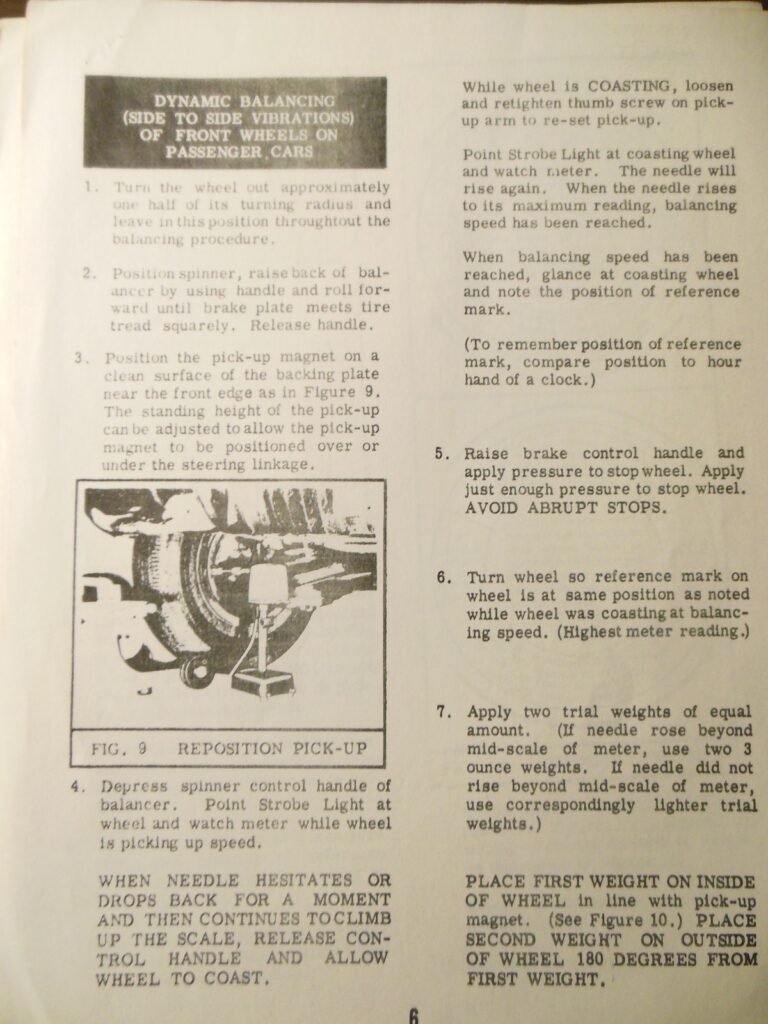
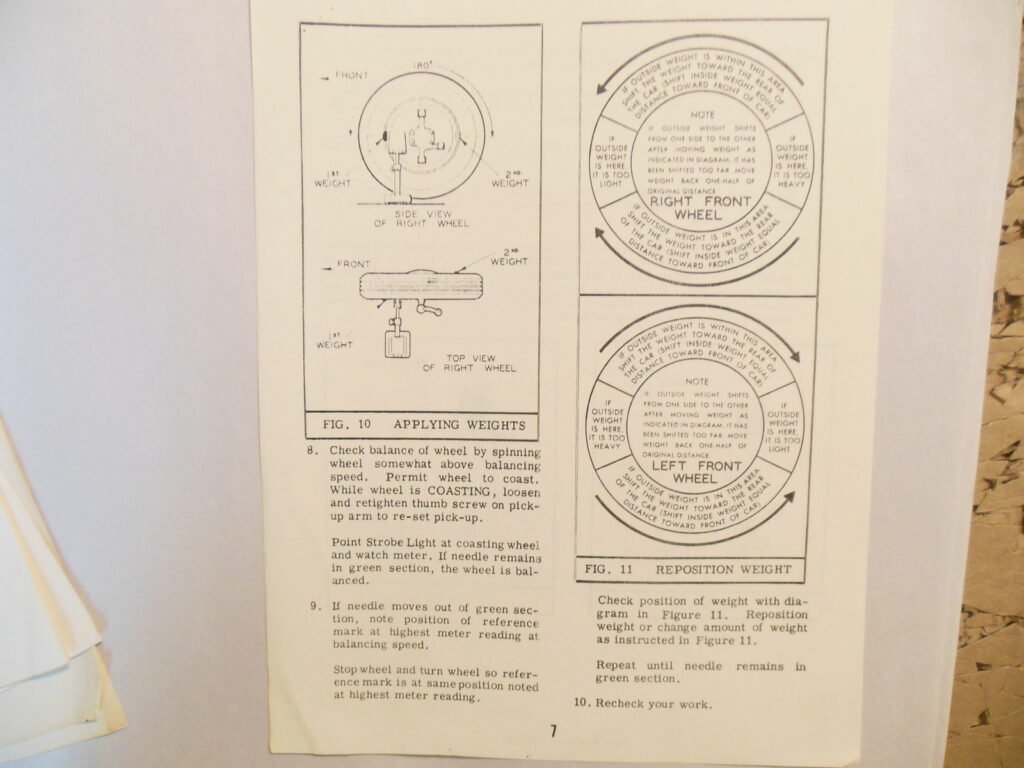
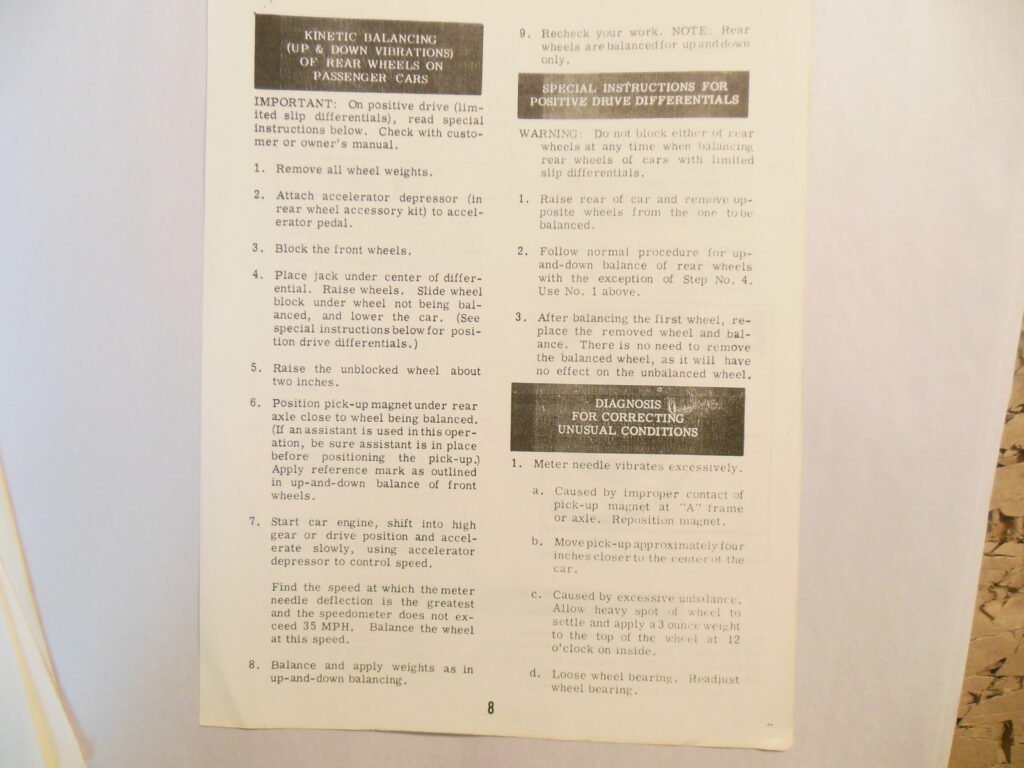
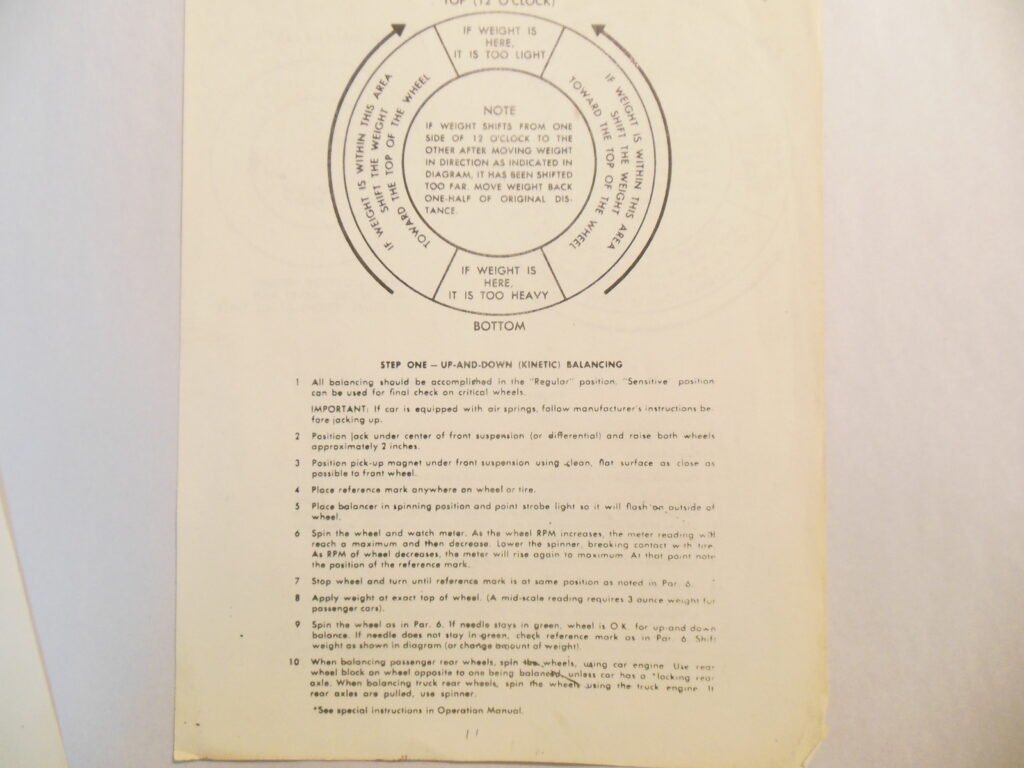
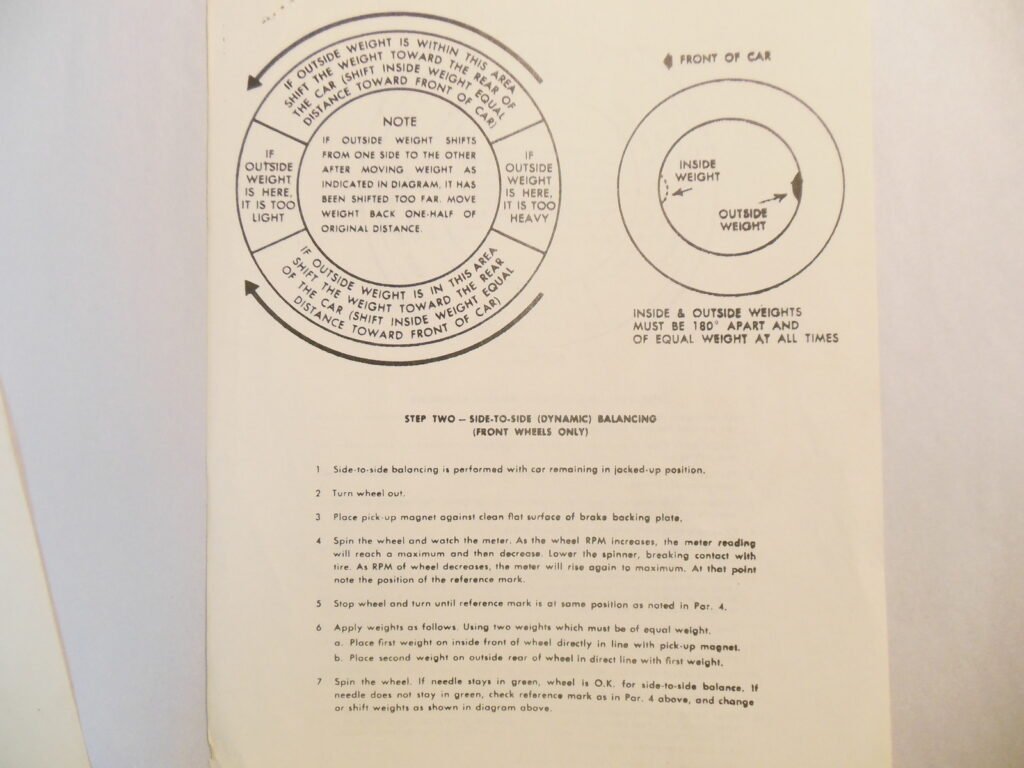
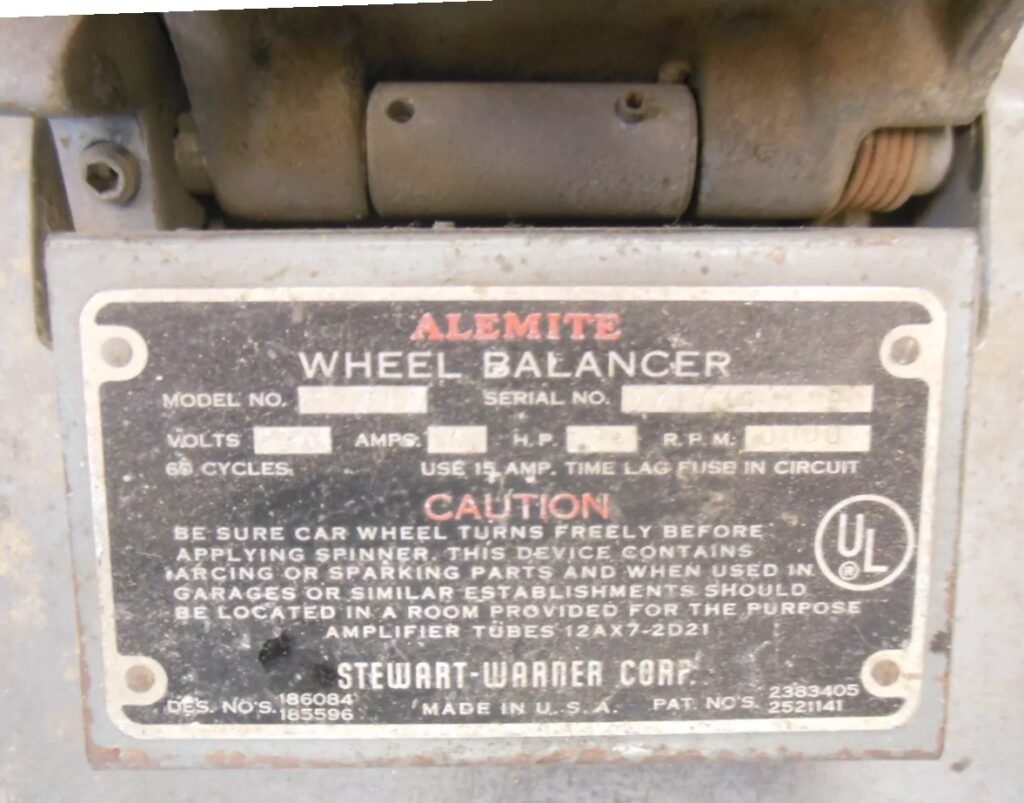
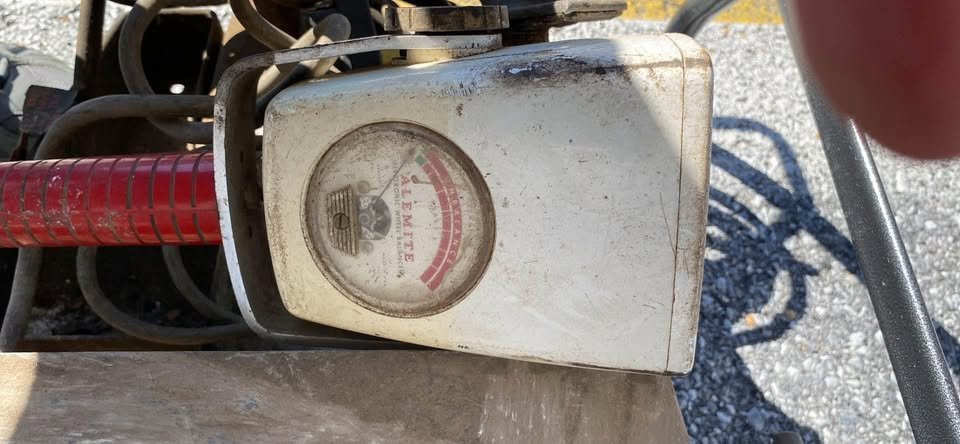
1966 Alemite Strobe Light wheel balancer. – 7057 –
INTRODUCTION
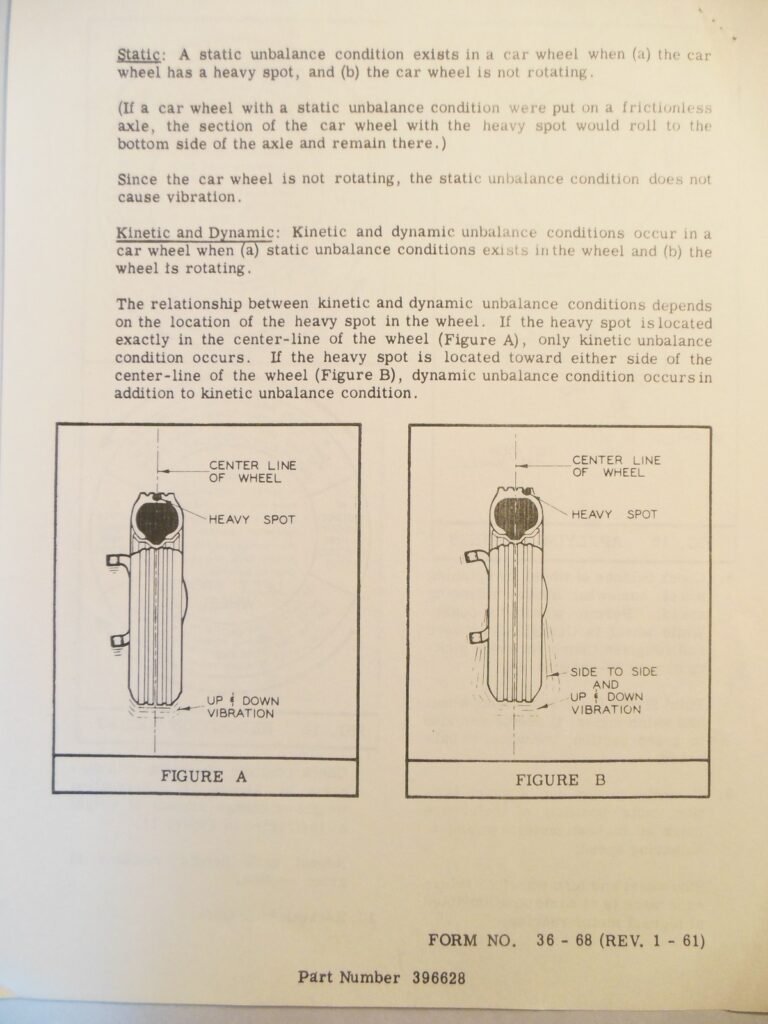
This manual provides step-by-step instructions for using the “Alemite” Electronic Wheel Balancer. The wheel balancer is used in detecting and correcting unbalance conditions in rotating car wheels. An unbalance condition is corrected by attaching a weight to the car wheel rim as a counterbalancing force. Through the use of the wheel balancer, the location for attaching the weight and the amount of weight to be attached are determined. For explanation of unbalance conditions, see pages 9 & 10.
With the electronic balancer, the location and amount of unbalance can be determined without anything being attached to the revolving wheel; in fact, the hubcap need not be removed during balancing procedure.
DESCRIPTION
Our electronic balancer consists of three basic units:
- Wheel Spinner – Used only for spinning the front wheels.
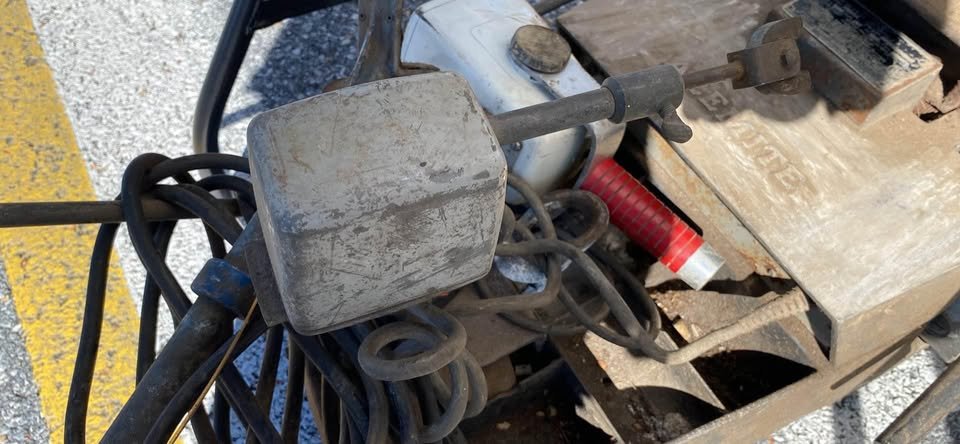
- Pick-Up Unit – Placed under the front suspension or axle to convert the mechanical motion of the suspension into electrical signals and transmit these signals to the meter and strobe light.
- Portable Strobe Light – Contains a meter to indicate an unbalance condition and a light designed for observing objects revolving at high speed. A two-position switch on the Strobe Light controls the sensitivity of the meter:
- Switch position #1 (Regular) – Used throughout the balancing procedure.
- Switch position #2 (Sensitive) – Used only for re-check on critical wheels.
The Strobe Light will only let you see the position of the wheel when the heavy part is in the down position. When the wheel is stopped and turned to the position shown when using the Strobe Light, the weight should be attached at the top of the wheel.
The instructions are structured so that one front wheel is fully balanced—both kinetically and dynamically—before moving on to the other front wheel. The rear wheels are balanced kinetically only.
BE SURE TO READ COMPLETE INSTRUCTIONS BEFORE USING BALANCER.